Wednesday, 14 September 2016

The Langurs Project (Updated)

Those of us living in Penang have grown up with the fact that there are and hopefully, always will be monkeys at the Botanic Gardens. But few of us give our monkeys much thought other than as adorable curiosities to be shown to tourists or friends from other places. After all they are practically ubiquitous to the extant of being nuisances occasionally. What we don't realise is that it will take hard work to keep our beloved monkeys.

Members from The Friends of Botanic Gardens Society attended a talk in support of the Langurs Project given by Ms Joleen Yap at the Spice Gardens. The aim of the talk was to educate the public on the langurs of Penang Island. A graduate student of the USM, Ms Yap and her team under the supervision of Dr. Nadine Ruppert are studying the langurs in the Teluk Bahang, Botanic Gardens and Cerok Tok Kun Forest Reserves.
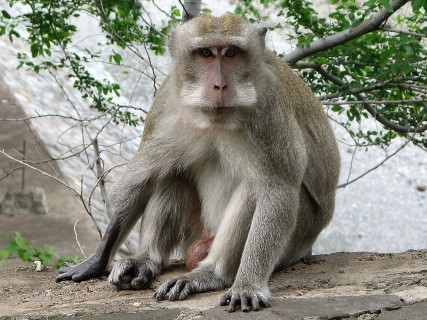
So what are langurs? For starters, they are not macaques, the more commonly seen denizens of the Gardens' trees, lawns and practically everywhere else they can beg or steal free food. This is a macaque.

This is a langur. Langurs are also monkeys. Members of the genus TrachypithecusPenang's langurs are also known as Dusky Leaf Monkeys and are different from the Gray or Hanuman Langurs of India. Our langurs are very shy, much darker and have very sweet faces like this one seen at the Gardens. 


They are also classified as Near Threatened (IUCN 3.1) on the IUCN Red List of Threatened Species* (see below) though our Penang langurs, cute as they might be, have not been properly studied before Ms Yap's academic research study.

The purpose of Ms Yap's study is to identify our local langurs' Diet, Activity Pattern and Habitat Use. Ms Yap's study is a primary base-line study and very important in determining conservation efforts. 

Ms Yap currently has a study grant from the Rufford Foundation but more local sponsorship and participation would certainly help to achieve the noble aim of her work. 

The Friends of the Botanic Gardens Society is supporting Ms Yap's efforts and we hope to hold a similar talk for our members and the public if there is sufficient interest.

Please indicate your interest by emailing your response to our email address at Botanika with the title: Langurs talk: OK. 


*The IUCN Red List or IUCN Red List of Threatened Species (sometimes just Red Data List) is the interntaional community's most comprehensive inventory of the conservation status of biological species world-wide. The International Union for the Conservation of Nature (IUCN) is the world's main authority in such matters and Regional Red Lists assess the risk of extinction of various species within each of those regions.


Thursday, 8 September 2016

Printing On Coloured T-shirts

Learn how to print your own designs with beautiful leaves on black or coloured t-shirts! It's fun and it's a really useful way of recycling old t-shirts to make them new again.

From free-form designs to patterns, plant sprays and more, we teach you how to print long-lasting images on your own coloured t-shirts that will last through repeated washing. 

Day/Time : Saturday either 1.30pm - 3.00pm or 3.30pm - 5.00pm
Maximum no. of participants : 6 per session
Open to Members, Non-members and Children over 8 years of age
Price per participant :
Members : RM15.00 per person per lesson
Non-members : RM20.00 per person per lesson


The following Terms and Conditions apply -
1.Participants must bring ONE black or dark-coloured T-shirt of their own.
*Note : T-shirts MUST NOT be 100% cotton. 
2.Participants who do not have their own black T-shirts may buy one from us.
3.Participants who wish to do extra pieces may also buy one of our black T-shirts.
4.Members price for black T-shirts is RM15.00 per pc.
5.Non-members price for black T-shirts is RM18.00 per piece.

We'll provide suitable paint or dyes, brushes and palettes for participants, as well as lessons on how to make or form your own designs or patterns.


Friday, 26 August 2016

Food Testing Is Fun!

Over at the Friends of the Botanic Gardens Society Outreach office premises, we dearly love our tea and lunch breaks because sometimes our members kindly bring some of their latest culinary discoveries for taste-testing. Of course, it isn't always a formal "I'm bringing some goodies for you all to try out," kind of situation. Very often, a member will discover some new food stall or recipe and just bring some delicious titbits to share.

And it was during one of these tea breaks that the subject of salads and dips came up. With the different herbs we have growing in our garden, the main subject of conversation was using these aromatic plants in the easiest (and tastiest) of ways. Salad dressings and dips!

A bit of research tells us that apart from cooking it in soups or curries our neighbours up north, the Thais, use lemongrass as a salad dressing, too. A common combination is ginger, coriander (Americans call it cilantro), garlic, lime juice and chili. The Italians, on the other hand, favour oregano, basil and parsley with freshly ground black pepper and balsamico (balsamic vinegar)or white wine vinegar mostly whereas French dressing is much richer with yoghurt, and Dijon mustard added to the herbs. 

So naturally, everyone wanted to try making their own salad dressings and dips with the herbs from our garden. Some of our more conscientious members even went on-line to look for classic recipes to use as reference for their own experiments while the free-spirited ones simply winged it, but a lot of very delicious herb dips and salad dressings were discovered (and tasted!) We'll be collecting the easiest and quickest ones to share with everybody at one of our upcoming Saturday activity demonstrations, naturally.

Don't forget to like our Facebook page or check back here at our blog for more information, updates and announcements about our new activities!


*Tip - Look for Friends of the Botani Gardens Society at Facebook!  


Friday, 19 August 2016

Favourite Herbs

Today’s blog post is going to be about some common herbs and easy but not common ways to use them because it rained this morning so there was no outdoor demonstration. It’s easy enough to toss a bunch of herbs together to add fragrance to any soup or salad dressing, but one of the most important things seldom discussed in cookery is the proper combination of herbs.


Mint (Mentha asiatica)
In Penang, we use mint for nyonya laksa (white rice noodles in a spicy fish broth) and in all kinds of Malay-style kerabu salads. Mint also goes well with seafood and red meat, cutting down on the fishy odour as well as the strong ‘meaty’ smell from beef, mutton or lamb. That’s why it’s used in lamb or mutton korma. But because of its strong fragrance, you have to be careful when combining it with other herbs which are more delicate.

Lemongrass (Cymbopogon citratus)
A great favourite in local cookery, lemongrass is used in Malay, Chinese and Indian dishes, as well as Thai and Burmese cooking. It’s citrusy perfume is strong but has a delicate body so larger quantities are needed when combining it with garlic, onions, mint or the local form of basil. You can make tea, puddings, jelly and even cake with it. It goes well with mint and laksa leaves, too! Incidentally, do you know how to differentiate between lemongrass and citronella (which isn’t good eating)? Scroll to the bottom for the trick!

Laksa leaves (Persicaria odorata)
Laksa leaves are also called Vietnamese coriander. They're strongly perfumed, and go well with lemongrass and mint in soups and curries. But laksa leaves can also be eaten in a salad (partner it with other strong-smelling vegetables!) or stir-fried with minced meat or chicken and a bit of soy sauce, oyster sauce or Thai fish sauce (nam pla) as a substitute for krapow or Thai basil (Ocimum basilicum) and you will get a lovely dish to go with white rice. Add a bit of bird’s eye chilli (chilli padi) too if you want, for the extra fragrance.

Dill (Anethum graveolens)
Though not native, it grows very well in Penang. Its light, almost liquorice fragrance combines beautifully with seafood and lemon juice. Just wrap some fish in butcher’s paper or baking foil, throw in a sprig of dill, a dab of butter, a squeeze of lemon (put a slice of lemon in, too), a sprinkle of white wine (if you want), and chuck the whole thing in an oven or steamer for about 10 minutes and you’ll get a nice poisson en papillote without having to go to a highty-tighty restaurant and pay premium prices. It works with prawns, too!


Some members also happened to drop by after the rain stopped and wanted a quick lesson on printing over black and coloured t-shirts so that’s what we did instead. Here’s a look at the students’ work from this morning.

Here’s a bit of extra good news. We’ll be adding simple cooking with local herbs to our monthly activities. Different ways to use herbs is usually popular, so don’t forget to check back here regularly for news about our monthly activities!


Pssst! How do you tell the difference between lemongrass and citronella? Citronella stalks are pinkish while lemongrass stalks are green! 

Saturday, 13 August 2016

Ibiden EHS Dept Rainforest Walk

What a busy Saturday today has been! And luckily for everyone, the weather held up in spite of black clouds and a very fine spray of rain just as activities were about to commence. 


First up at 8.30 am were the ladies and gentlemen from the EHS Dept. who'd come for the Rainforest Walk. The walk was conducted by our Vice-President, Dr. Liew Kon Wui, with Dr. Conchita Nolan, and Lili Cheah acting as his backup.

The group of 20 ladies and gentlemen tackled the mile-long botanical trail from the Gazebo, along the Lower Circuit Road and ending at the Lily Pond, in good time,

 It was an informative and interesting excursion as Dr. Liew briefed them on things as diverse as the different strata in the tropical rainforest canopy, the many kinds of trees around the Garden's slopes, the ferns and the flowers at ground level.

Participants were given drinks, a handout with diagrams of the various types of plants that make each specific level their home, and a brochure with highlights of the intriguing things to be found along the walk. Although the track was a bit slippery because of the previous few days' rainy weather, everything went off well.

There was a bit of a disappointment, however. The famous Black Lily (known as the keladi murai locally) was not in bloom when the group went on their track this morning. The exotically coloured purplish black flowers with gracefully bowed petals would have made for a lovely highlight around the Lily Pond area but unfortunately, it was not blooming season for this special bloom.

Meanwhile back at our Outreach premises, the usual Saturday morning demonstration went on as usual. The plant painted this week was a simple Helliconia with three leaves. It will be part of the T-shirt painting series of lessons since only two basic types of brushstrokes are required to do it.

Watch out for a third plant next week! We'll be doing fruiting lime tree branches!

Just to let everyone know, we're preparing a simple easily learned syllabus and teaching aids for T-shirt painting so that we can eventually start classes for those interested to learn basic one-stroke painting with dyes to make their own hand-painted T-shirts.

Friday, 5 August 2016

Wearable Art!

We've been having regular t-shirt printing sessions for members at our Outreach office most Wednesdays. Our art and craft group members use the leaves and flower from our garden mostly, but some have brought really unusual and beautiful specimens from their own homes to use. 

Indeed, our dedicated members have produced such truly lovely pieces that we were delighted to put them up on sale at our Garden Shop.

That's right. 

All those beautiful t-shirts you see at our Shop are one-of-a-kind hand-printed pieces of art that you can wear! But did you also know that we've been having little outdoor demonstrations of art and craft activities right in front of our office for the last four weeks? 

We kicked off our latest programme and activity developments quite smoothly with a couple of weeks of black and coloured t-shirt printing with leaves and flowers. From 8.00am to 10.00am, joggers and walkers passing by have been drawn to watch our mini demonstrations.

It's all part of our latest activity and programme development plan. For now, while we've been in the research and planning stage, the activities have been for 'Members Only' but we're glad to inform everyone that we'll soon be offering our latest activities to the public! 

We started off our Saturday demonstrations by printing only on adults' black t-shirts but now we also have equally prints on children's wear. Even those t-shirts coloured deeper shades than light pink or pale blue. So now, you can buy colourful printed t-shirts for kids at our Outreach office premises, too.

This morning's outdoor demonstration was rather different, however. Have a look at this t-shirt. Can you guess what we were demonstrating?

That's right. We're starting t-shirt painting classes for our members. And not just draw with a pencil and then fill-in-the-lines painting but Chinese watercolour-style painting! To make it easier and more enjoyable for everyone to learn, we've simplified the techniques to just 4 basic strokes and divided the programme into 4 parts - one flower or plant for each session.

Today's demonstration was on how to paint the butterfly pea flower more commonly known as bunga telang in Malaysia.

Next week's demonstration will be the heliconia flower, so don't forget to drop by and have a look. There'll be plants on sale, too!


Friday, 29 July 2016

Koala Kids Enrichment Center

Thirty-four children and four teachers from Koala Kids Enrichment Center had an exciting day at the Friends' Outreach premises last Friday, the 22nd of July.

The cute kids came in a big bus with Koala Kids' Business Director, Mr Saw Leng Syn,at 9.00am and were welcomed by the committee and volunteers of the Friends of the Penang Botanic Garden Society. 

The children, all below 7 years of age, were sweet and extremely well-behaved. Thanks to their teachers, they all lined up quietly before separating into two groups to participate in two educational activities - Seed Safari and Worm Hotel. 

Those children going on the Seed Safari, conducted by Friends' Vice-President Dr. Liew Kon Wui, were given vests to wear for identification purposes before setting off on a little trek to look at trees, plants and their seeds.

They were taught about how different kinds of plants produced different kinds of seeds and shown a variety of seeds. The children were given little specimen collection bottles of their own so that they could collect any of the different plant parts, flowers or seeds that caught their eye during their safari.


Their little adventure concluded with a craft session at Outreach as they were taught how to make collages from seeds and the various leaves and flowers they had collected during their walkabout. 

The children had a fun time gumming various kinds of seeds to make pictures of flowers, butterflies, snakes, and leaves. The more creative ones added small leaves and flowers from their specimen bottles.

The other group learnt all about worms. They were taught about how to find worms, what worms liked to eat, where they lived and the different parts of a worm.

The children also learnt how useful worms were to the environment before being given the opportunity to handle some worms of their own. 

The adorable little children handled their worms quite fearlessly and had a fun time helping to build a worm hotel step by step. In fact, some of the children who had been a little fearful of worms at the beginning, ended up asking for extra worms to put into their little worm hotels.

In the process, they learnt about creating an ecologically viable environment for their worms to survive. 

After a short break, the two groups switched places and enjoyed their second round of activities for the morning. Their fun nature awareness programme ended at 1pm when the bus came for them.